Create a Drop Zone for Everyday Essentials
Give keys, bags, mail and other daily carry items a convenient landing spot with a simple process for choosing, setting up and maintaining it.
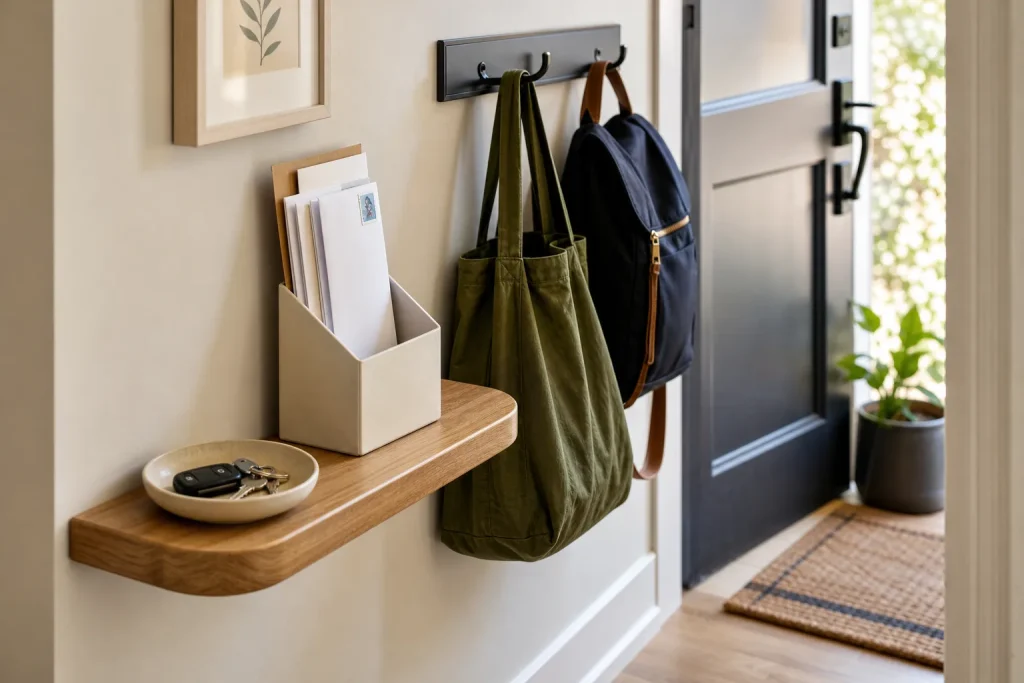
Keys left on a counter, a bag on a chair and mail slipping beneath a coat can turn the trip through the front door into a daily hunt. A drop zone gives these items a defined place to land without requiring a full entryway or a major rearrangement. Its purpose is narrow: make the handoff between arriving and getting on with the day easier.
Before choosing containers or fittings, decide what the area must do and what it must not do. It should handle a short list of items without obstructing the entrance or becoming a second mailroom. The following guide focuses on those boundaries, including a fully worked hypothetical arrangement for a small entrance.
Set the Drop Zone’s Boundary
Choose a small, clear area close to the entrance, but outside the path of doors, stairs and regular foot traffic. This is a functional boundary, not an invitation to claim every nearby surface. Decide which everyday objects belong there and which do not. Keys, a frequently carried bag and an outgoing shopping bag may qualify; packages, tools and papers that need extended attention usually need a separate destination.
Use a simple rule to settle uncertain items: if something is carried through the door regularly and must be retrieved before leaving, it may belong in the drop zone. If it arrives occasionally or needs sorting, direct it elsewhere. For example, if an envelope needs a reply, place it with the household’s task papers rather than letting it occupy the key dish. This separation keeps the landing place available for quick exchanges.
Give Each Essential a Distinct Destination
Match each item to a place that is easy to recognize and suited to its shape. Keys can go in an open dish or on a hook; a bag can hang from a suitable hook or sit in a designated floor space; outgoing mail can stand upright in a small holder. Avoid grouping unrelated objects in one container if that makes retrieval harder. Clear destinations matter more than matching colors or materials.
Make shared arrangements legible at a glance. A separate hook for each regular bag can prevent items from being mistaken for one another, while a shared key dish can work if everyone knows to return keys there. If an item is awkward to put away, change its destination rather than adding a complicated rule. The goal is to reduce the small decisions made at the door, not to create a new system that requires explanation.
Choose a Layout That Preserves the Entrance
In a narrow entrance, a shallow ledge or a small wall-mounted organizer may preserve floor space better than a freestanding table. A nearby existing counter can work where there is no entry hall, provided the drop zone does not displace food preparation or another necessary task. In a shared corridor, keep belongings within the household’s own space and avoid narrowing the route others use.
For wall-mounted storage, do not infer suitability from appearance alone. Wall materials, hidden services, the fitting design and the intended load all matter. Follow the fitting manufacturer’s instructions, check the wall type and stated load guidance, and do not exceed the rating for the complete installation. If the wall or fitting is unclear, the load is substantial, or drilling could contact wiring or plumbing, leave the installation to a qualified professional. A freestanding or existing surface may be the safer alternative.
Keep Daily Items Separate from Temporary Tasks
A drop zone is easiest to use when its contents are predictable. Give daily essentials the most accessible positions and keep temporary tasks elsewhere. A slim holder might receive outgoing letters, but incoming paperwork that needs decisions belongs with the household’s regular paper-sorting place. Packages awaiting attention should not sit in the key dish or cover the surface used for everyday items.
Set a visible limit rather than adding more storage whenever the area fills. If the mail holder is full, sort it before putting in more; if bags crowd their hooks, move occasional-use bags to their usual storage. This creates a decision point: either an item still serves the arrival routine or it needs a different home. The limit helps prevent a convenient landing area from quietly becoming a collection point for unrelated belongings.
Make the Routine Quick to Repeat
Attach the return action to something already happening. On arrival, put keys in their dish, hang the bag and place outgoing papers in their holder. Before leaving, take the items needed for that trip and return anything that does not belong in the entrance. Keep the sequence short enough to follow while carrying other things or managing a busy doorway.
Include a small reset in an existing household routine, such as clearing the entrance before bed or while preparing to leave. Return stray objects to their proper rooms and remove papers that no longer need attention. If the same item repeatedly ends up somewhere else, change its destination or the boundary of the system. Do not respond automatically by adding a container; the misplaced item may belong to another routine entirely.
Work Through a Hypothetical Small-Entrance Setup
Consider this invented scenario: one adult uses a narrow apartment entrance and regularly carries keys, a work bag and a reusable shopping bag. The door must open fully, there is no room for a table, and an existing shallow ledge sits outside the door’s swing. The task is to keep the walking route clear while making the three items easy to retrieve. These are hypothetical details, not a report of an actual household.
First, exclude the door swing and walking path from the usable area. Next, place a small open dish on the existing ledge for keys and assign the two bags separate existing hooks only if those hooks are already suitable for their loads; otherwise, choose another secure, non-obstructive destination or ask a qualified installer about a wall fitting. Keep the reusable bag visible and return the work bag to its assigned place. The resulting arrangement uses the ledge and hooks without adding floor furniture. Its tradeoff is that the ledge must remain clear, and the bags need secure homes that do not compromise the wall or entrance.
Conclusion
A useful drop zone is a small, defined handoff point, not a general storage solution. Give everyday carry items distinct destinations, keep task papers and occasional belongings elsewhere, and protect the entrance’s clear route. When choosing wall-mounted storage, rely on the fitting instructions and the actual wall conditions rather than assumptions; seek qualified help when either is uncertain.
Keep the routine brief and let recurring clutter identify the problem. An item that continually lands elsewhere may need a different destination, or it may not belong in the drop zone at all. A compact arrangement that respects the household’s movements can make arriving and leaving more orderly without turning the entrance into another project.