A Useful Checklist for Choosing Household Storage
Compare storage by the job it performs, its construction, care requirements, safety documentation, and the tradeoffs it creates before bringing it home.
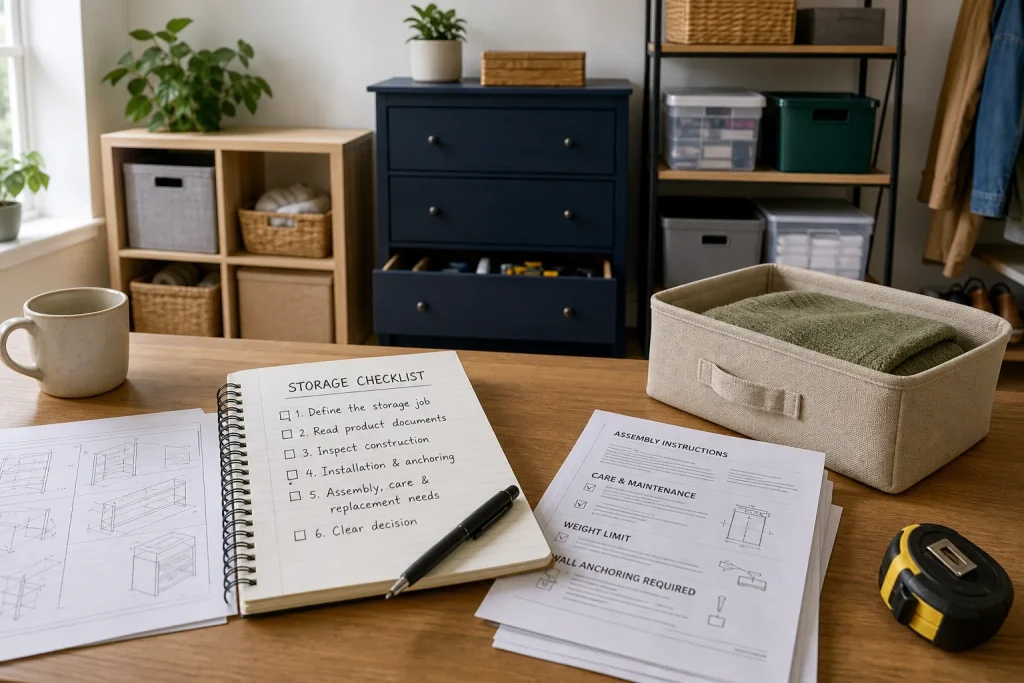
Storage choices are often compared by appearance or capacity, but those qualities alone do not reveal whether a cabinet, shelf, or container is a sound purchase. A more useful comparison asks what the item is made to do, how its parts are put together, what care it needs, and what limitations the maker identifies. Those questions help distinguish a product that merely looks convenient from one that is understandable to assemble and maintain.
Use the checklist below to compare options on evidence you can inspect: product documentation, visible construction, stated care instructions, and the demands of the intended contents. Safety-related installation is different from ordinary product comparison; the correct anchoring method depends on the furniture and the building. Where instructions do not settle the question, ask the maker or a qualified professional rather than guessing.
Define the Storage Job Before Comparing Products
Describe the contents as a practical job rather than a broad category such as “household items.” Note whether objects are soft or rigid, fragile or robust, and used together or separately. A box holding seasonal fabric has different demands from a drawer intended for small tools. This distinction helps you examine whether the product’s compartments, openings, and surfaces suit what will actually go inside, instead of being persuaded by a versatile-looking design that may not serve any one task well.
Separate essential requirements from preferences. For example, a closed front may matter if the contents need protection from dust, while a decorative finish may simply be a preference. Compare products against the essential requirements first, then consider appearance among the suitable candidates. This method makes the decision more distinctive than choosing by room or routine alone: it evaluates whether the product’s stated construction and features are appropriate to the specific storage job.
Read Product Documents for Limits and Requirements
Look for the product’s assembly instructions, care guidance, stated use, and any restrictions on placement or contents. If documents are unavailable before purchase, ask the seller or maker how to obtain them. Treat unclear or conflicting instructions as unresolved information, not as permission to assume that a product can be used in any way. Documentation can also clarify which parts are included, whether specialized tools are needed, and whether the maker identifies compatible replacement components.
Check that the documents refer to the exact model and configuration being considered. A description for a similar-looking unit may not cover its fasteners, moving parts, or installation requirements. If a critical detail is missing, ask a specific question and keep the answer with the product information. If the maker cannot clarify a requirement that matters to your intended use, compare another option with clearer documentation rather than improvising an assembly or care method.
Inspect the Construction You Can Actually See
Examine joins, edges, handles, hinges, runners, and supports, and note anything that appears loose, damaged, or difficult to operate. These observations are not a substitute for product specifications, but they can help you identify questions to raise before buying. Ask whether moving parts are replaceable, whether the finish has particular care requirements, and whether the maker describes the piece as suitable for the intended setting. Avoid inferring a load limit or durability claim from appearance alone.
Consider how the materials fit the expected care. A container near an entry may encounter damp belongings or grit, while a bedroom drawer may hold clean textiles. Consult the maker’s guidance before using cleaners, liners, or treatments that could affect a finish. If a product depends on a mechanism you do not understand, ask how it should be operated and maintained. Choose on the basis of clear information and visible condition, not on a confident impression that an unfamiliar feature must be robust.
Resolve Installation and Anchoring Separately
For tall furniture or any product whose instructions call for anchoring, follow the applicable maker’s instructions for the exact unit. Do not select a wall fixing by appearance or rely on generic advice: the appropriate method depends on the furniture, wall construction, and fixing specified. If the wall type is unknown, the instructions are incomplete, or the required fixing is not available, pause installation and contact the maker or a qualified professional. A product comparison cannot determine a safe fixing for an unseen wall.
Check the installation documents before purchase for anchoring requirements, included hardware, and any stated limits on suitable surfaces. If the unit is intended for a home with children or pets, treat that as a reason to be especially careful about the manufacturer’s safety guidance, not as a basis for improvising. If instructions do not make clear whether anchoring is required or how to carry it out, do not guess or leave a required step unresolved; seek qualified advice or choose a product with instructions that address the situation.
Compare Assembly, Care, and Replacement Needs
Review the assembly sequence and identify the tools, help, and workspace it calls for. Decide whether those requirements are manageable in the location where assembly will happen. A product with fewer parts is not automatically the better choice, but instructions that are legible and complete make the expected work easier to evaluate. If a step depends on an unfamiliar tool or technique, ask the maker for clarification before purchase rather than assuming it will be straightforward.
Then compare ongoing care and repair information. Look for guidance on cleaning, adjustment, and obtaining replacement parts, and note whether the maker identifies components that are not replaceable. If ordinary upkeep appears to require materials or expertise you do not have, weigh that burden against the product’s other advantages. A simpler mechanism may be easier to understand, but do not treat simplicity as proof of long service. Choose based on the care and repair information available for the particular item.
Use the Checklist to Reach a Clear Decision
Apply each item to the exact product and record the observation before deciding. If an essential answer is unknown, treat it as an unresolved question rather than a pass. This keeps the comparison focused on product evidence and tradeoffs, rather than allowing attractive styling or a broad promise of flexibility to conceal an important omission.
- Intended contents: Check that the product’s openings and compartments suit the actual items; if they do, keep it in consideration, but if they do not, choose a different layout.
- Product documents: Check that assembly and care instructions match the exact model; if they do, review their requirements, but if they are missing or mismatched, ask the maker or compare another product.
- Construction: Check visible joins and moving parts for damage or unclear operation; if they appear sound and understandable, continue comparing, but if they are damaged or uncertain, request clarification or reject the item.
- Care requirements: Check whether the stated cleaning method suits the intended setting; if it does, include the product in the comparison, but if it conflicts with your needs, choose a more suitable finish or material.
- Assembly: Check the stated tools, help, and workspace; if these are available, proceed with the comparison, but if not, ask about assistance or select an easier-to-assemble option.
- Anchoring: Check the exact maker’s instructions for whether anchoring is required and which method applies; if the instructions fit the furniture and known wall, follow them, but if the wall or method is uncertain, pause and consult the maker or a qualified professional.
- Replacement parts: Check whether the maker explains how to obtain relevant parts; if needed parts are available, weigh that positively, but if availability is unclear, ask before purchase or accept that repair may be limited.
Hypothetical worked example: Imagine a buyer considering a tall cabinet for a collection of board games. The starting information is that the games vary in size, the intended wall has not been identified, and the buyer has not yet seen the assembly instructions. First, the buyer checks the cabinet’s compartments against the largest game boxes and finds that one shelf arrangement would not fit; that configuration is set aside. Next, the buyer obtains the exact model’s instructions and sees that the maker specifies anchoring. Because the wall construction is unknown, the buyer does not choose a fixing. The buyer asks a qualified professional to assess the wall and method. If the specified installation is suitable, the cabinet remains an option; if it is not, the buyer compares a shorter cabinet or separate containers. The tradeoff is clear: retaining the tall cabinet depends on resolving installation, while an alternative may mean dividing the collection.
A sound storage purchase is not simply the product with the most features or the neatest appearance. Compare the intended job, exact-model documents, visible construction, care demands, and installation requirements, and make unresolved safety questions a reason to pause. The result is a decision grounded in what the maker says and what you can responsibly verify, with tradeoffs made explicit before the item enters your home.